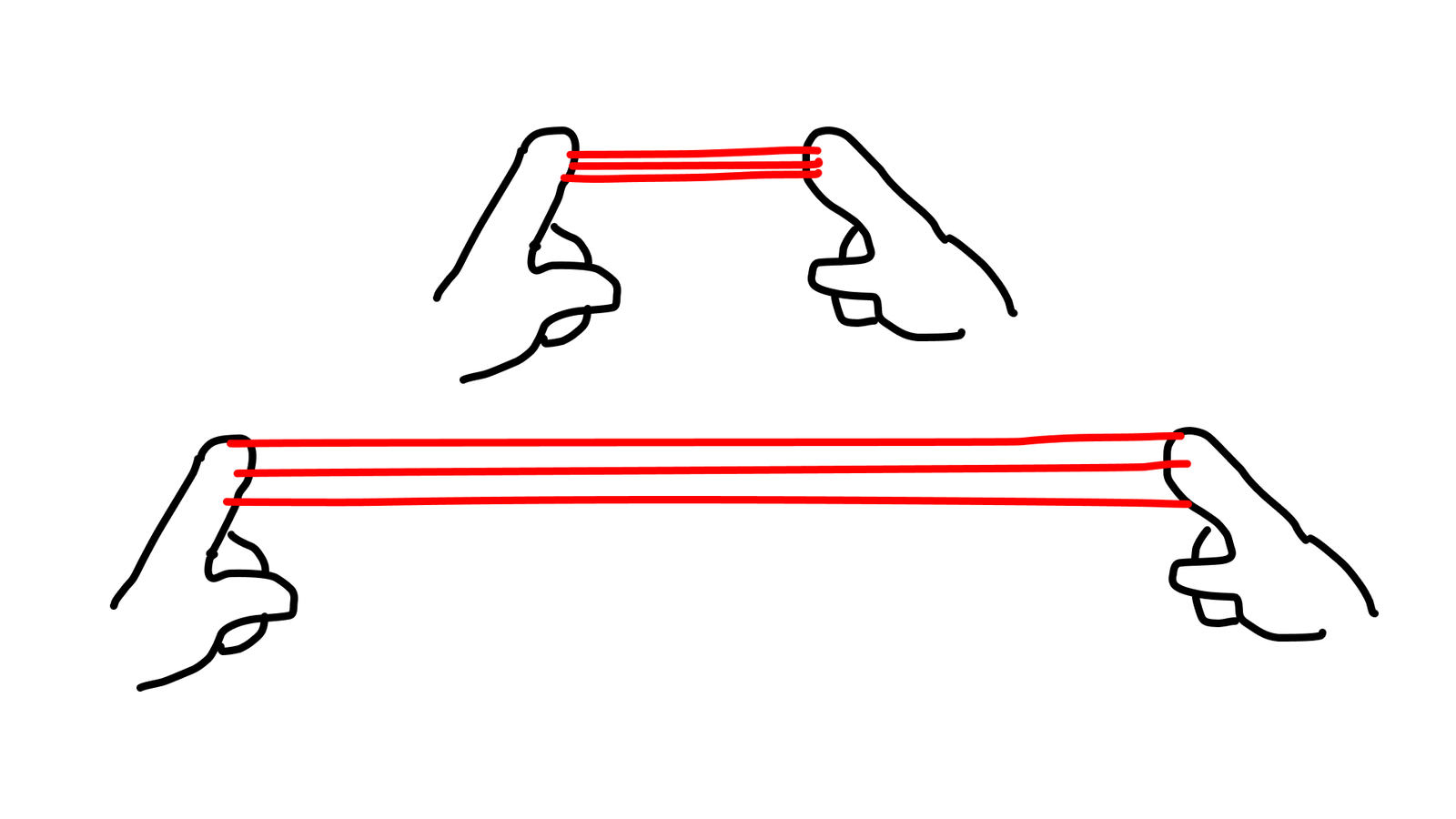
I like designer Kenya Hara’s phrase, “design is the control of difference.” I think this could also be rephrased as:
“Design is the work of adjusting the relationships between pieces of information.”
By adjusting the relationships between pieces of information, we can create foreground and background. To create a foreground, the differences between pieces of information must be increased; to create a background, those differences must be reduced.
Through this kind of adjustment, a flow of gaze is created within information. Like wind blowing down from a mountain, the eye flows from areas of high contrast to areas of low contrast. Using this principle, a designer can control what unfolds in the foreground and what unfolds in the background of the reader’s awareness. Which part is emphasized to become the foreground, and which part is pared back to become the background, depends on the designer’s own judgment.
For example, if the copy on a thumbnail expresses the essence of something in the most compelling way, that copy is made the foreground. In this case, I believe the design should be understated. This is because the part meant to be the foreground lies not in the expression but in the content. By reducing the design’s difference from the surrounding information and keeping it plain, the content becomes easier to notice. If a glass is too ornate, what’s inside it fails to catch the eye.
Conversely, there are times when the expression itself, within the information, is compelling, and reveals the essence better than words could. In this case, the expression is given strong contrast to make it the foreground. This is because the context carried by the content can look different depending on the vessel it’s presented in, and the content itself can be shown in a more compelling way.
Since learning the concept that “design is the control of difference,” I’ve tried not to focus on individual parts but to grasp the relationships between pieces of information. This is because I learned that when one element changes, it’s not just that element that changes — the relationship between it and other elements changes as well.
At first I applied this principle only to design, but I believe it applies to any work that deals with information. Not only designers, but everyone can design information in their own way.